Custom Mobile Software Development: Everything Businesses Need to Know Before Building a Mobile App
Custom Mobile Software Development: Everything Businesses Need to Know Before Building a Mobile App
A smartphone can be more than a communication device. For modern businesses, it can become a complete platform for selling products, managing customers, coordinating employees, accepting payments, delivering services, collecting information, and automating everyday operations.
However, businesses do not all work in the same way.
A standard mobile application may provide useful features, but it may not support a company’s unique processes. When existing software cannot provide the flexibility a business needs, custom mobile software development can be a practical alternative.
Custom mobile software is designed and developed around a specific business, product, audience, or operational requirement. The result can be a mobile application that does exactly what the business needs instead of forcing users to work around predefined functionality.
This guide explains what custom mobile software development involves, how businesses can benefit from it, what features can be developed, how the development process works, and what to consider before investing in a custom mobile solution.
What Is Custom Mobile Software Development?
Custom mobile software development is the creation of mobile software specifically for a particular business or project.
Rather than downloading an existing application and accepting its available features, a company can work with a development team to define the functionality it needs.
A custom mobile project may involve:
- iOS application development
- Android application development
- Cross-platform development
- Backend systems
- Database architecture
- API development
- Cloud infrastructure
- User authentication
- Payment processing
- Push notifications
- Administrative dashboards
- Analytics
- Third-party integrations
The final product can be designed for customers, employees, business partners, or internal operations.
Why Businesses Build Custom Mobile Software
The primary reason businesses invest in custom software is that their requirements are different.
Consider a company that manages thousands of service appointments.
A basic booking application might allow customers to select a date and time.
However, the company may also need:
- Different appointment types
- Employee assignment
- Service-area restrictions
- Customer records
- Deposits
- Automated reminders
- Cancellation rules
- Staff availability
- Reporting
- Administrative approval
A standard booking application may not support all of these requirements.
Custom development allows the business to build these workflows into the software.
Custom Mobile Software Can Solve Specific Problems
The best custom applications begin with a business problem.
For example:
Problem: Manual customer bookings
Solution: A custom appointment application.
Problem: Employees use spreadsheets to track field jobs
Solution: A mobile workforce management system.
Problem: Customers cannot easily track orders
Solution: A custom order-tracking application.
Problem: Multiple business systems don’t communicate
Solution: A mobile application connected through APIs.
Problem: Customers use several platforms to access services
Solution: A centralized mobile customer portal.
The technology should support the business objective rather than exist simply because having an app seems attractive.
Common Types of Custom Mobile Applications
Business Management Applications
These applications help companies manage internal operations.
They can include:
- Tasks
- Employees
- Reports
- Customers
- Inventory
- Scheduling
- Documents
- Notifications
Customer Service Applications
Businesses can provide customers with a dedicated mobile channel.
Features may include:
- Account management
- Support requests
- Messaging
- Service history
- Notifications
- Payments
- Appointments
E-Commerce Applications
Custom shopping applications can provide:
- Product catalogs
- Categories
- Search
- Filters
- Shopping carts
- Checkout
- Payments
- Order tracking
- Customer accounts
Marketplace Applications
A marketplace can connect multiple types of users.
For example:
Customer → Platform → Service Provider
A custom marketplace may require profiles, listings, search, messaging, bookings, payments, reviews, and administration.
Delivery and Logistics Applications
Logistics software may include separate experiences for customers, drivers, and administrators.
A driver may receive an assigned delivery while the customer receives status updates through another interface.
The Difference Between Custom and Off-the-Shelf Software
Understanding this difference is important before making a development decision.
Off-the-Shelf Software
Off-the-shelf software is already built and designed for a broad group of users.
Advantages:
- Quick to start
- Existing functionality
- Usually easier to implement
- Lower initial development requirements
Limitations:
- Limited customization
- Restricted workflows
- Possible integration limitations
- Dependence on the provider
Custom Software
Custom software is developed around specific requirements.
Advantages:
- Flexible functionality
- Custom workflows
- Custom integrations
- Greater product control
- Ability to expand the system
Limitations:
- Requires planning
- Development takes time
- Initial investment can be higher
- Requires ongoing maintenance
The Core Benefits of Custom Mobile Software Development
1. A Solution Built Around Your Workflow
Instead of changing the way your employees work to fit software, the application can be designed around existing processes.
This can be especially valuable for businesses with specialized operations.
2. Improved Customer Experience
Customers can access services through a mobile interface designed specifically for them.
The business can decide which information customers see and which actions they can perform.
3. Greater Flexibility
New features can be added as requirements evolve.
The business isn’t limited entirely by another company’s software roadmap.
4. Integration With Existing Technology
Custom applications can connect with existing business systems where appropriate.
This may include:
- CRM platforms
- Payment systems
- Inventory software
- Accounting systems
- Maps
- Communication platforms
- Analytics services
5. Scalability
A properly planned architecture can support future growth.
The application can potentially expand from a small MVP into a larger platform as the business grows.
What Features Can Be Included?
There is almost no universal feature list for custom software.
The functionality should be based on the application’s purpose.
Common features include:
Authentication
Users can securely access their accounts.
Profiles
Customers or employees can manage personal or business information.
Search
Users can quickly find relevant products, services, locations, or records.
Payments
Businesses can integrate suitable payment services.
Notifications
Users can receive updates through push notifications.
Messaging
Customers, employees, or service providers can communicate within the platform.
Scheduling
Businesses can manage appointments, availability, and events.
Analytics
Administrators can view useful business and usage information.
Administration
Staff can manage the application’s data through a dedicated dashboard.
The Importance of a Backend
A mobile application often requires a backend system to function properly.
The backend can process requests, manage accounts, store data, and communicate with external services.
A simplified architecture might look like:
Mobile Application
↓
API
↓
Backend
↓
Database
This architecture allows mobile users to interact with business data without directly accessing the underlying database.
APIs and Mobile Software
APIs are important when an application needs to communicate with other software.
For example, an e-commerce application may need to communicate with:
- Inventory software
- Payment providers
- Shipping services
- Customer databases
An API can act as the communication layer between systems.
Custom mobile development is particularly useful when a business needs several systems to work together.
Designing the User Experience
A good mobile application should not require users to think about how the software works.
The interface should guide them naturally.
Before designing screens, developers and designers should understand:
- Who the users are
- What they want to accomplish
- What information they need
- Which actions are most important
- What problems currently exist
A simple user journey might look like:
Open App → Sign In → Select Service → Choose Option → Confirm → Receive Notification
Reducing unnecessary steps can improve the overall experience.
UI Design for Custom Mobile Applications
The user interface should reflect the company’s brand while remaining easy to use.
A custom UI can include:
- Brand colors
- Logos
- Typography
- Custom icons
- Navigation
- Cards
- Forms
- Dashboards
- Buttons
- Menus
Good design balances appearance with usability.
An attractive application that is difficult to navigate can still provide a poor user experience.
Choosing iOS, Android, or Both
Another important decision is platform support.
Businesses may choose:
iOS only
Suitable when the target audience primarily uses Apple devices.
Android only
Suitable for businesses targeting a specific Android-focused market or device environment.
iOS and Android
Suitable when the application needs broad mobile coverage.
The choice should be based on the target audience, business goals, technical requirements, and available budget.
Native vs Cross-Platform Development
Native Development
Native development creates software specifically for a mobile platform.
It can provide:
- Strong platform integration
- High performance
- Access to platform-specific capabilities
- Fine-grained control
Cross-Platform Development
Cross-platform development allows developers to create applications for multiple platforms using a shared development approach.
Frameworks such as Flutter and React Native are examples of technologies that can be considered.
Cross-platform development may be useful when a business wants to support multiple platforms while keeping development efficient.
The best choice depends on the requirements of the project.
How the Custom Mobile Development Process Works
1. Discovery
The development team learns about the business and its objectives.
This is where important questions are answered:
- What problem does the software solve?
- Who are the users?
- What features are required?
- What systems need integration?
- What platforms are needed?
2. Planning
The requirements are organized into a development plan.
Features can be divided into:
- Must-have
- Important
- Future
This prevents the first version from becoming unnecessarily complicated.
3. UX Planning
The team maps out user journeys and application flows.
This provides a blueprint for the interface.
4. UI Design
Designers create the visual experience.
The screens can then be reviewed before development begins.
5. Development
Developers build the mobile application and supporting backend infrastructure.
Depending on the project, development can include:
- Frontend
- Backend
- APIs
- Databases
- Authentication
- Integrations
- Administration
6. Testing
The software is tested to identify technical and usability problems.
Testing can cover:
- Features
- Devices
- Operating systems
- Performance
- Security
- APIs
- Payments
- Notifications
7. Deployment
The application is prepared for production and made available to its intended users.
8. Maintenance
After launch, developers can provide updates, fixes, improvements, and new features.
How Long Does Custom Mobile Software Development Take?
The development timeline depends on the scope.
A simple application with limited functionality may be completed much faster than a large platform containing multiple applications and complex backend services.
The timeline can be affected by:
- Number of screens
- Features
- Platforms
- Backend requirements
- Integrations
- Design complexity
- Testing
- Security requirements
- Changes during development
A detailed project specification usually provides a much more realistic timeline than estimating based on the idea alone.
How Much Does Custom Mobile Software Development Cost?
Custom mobile development can range from a relatively small project to a major software investment.
There is no single standard price.
The cost is influenced by:
- Project size
- Number of features
- Development platform
- Backend complexity
- API integrations
- Design
- Security
- Testing
- Maintenance
For this reason, businesses should request a project-specific estimate.
The cheapest quote isn’t always the best option. The quality of planning, development, testing, and long-term support can have a major impact on the final product.
Why an MVP Can Be a Smart Starting Point
A minimum viable product allows a business to launch the essential version of its idea before building every planned feature.
For example, a new service platform may initially include:
- Registration
- Profiles
- Service listings
- Search
- Booking
- Payment
- Notifications
Advanced analytics, loyalty programs, automation, and other features can be introduced later.
An MVP can help businesses test the concept and gather real user feedback.
Security Considerations
Security should be included throughout the development lifecycle.
Depending on the application, security considerations can include:
- Authentication
- Authorization
- Encryption
- Secure APIs
- Data protection
- Access control
- Input validation
- Secure sessions
- Monitoring
The security architecture should reflect the type of information and services handled by the application.
Testing Before Launch
Testing should not be left until the final day of development.
Developers can test features continuously throughout the project.
Testing may involve:
Functional testing
Does each feature work correctly?
Compatibility testing
Does the application work on supported devices?
Performance testing
Does the application remain responsive?
Security testing
Are user accounts and data adequately protected?
Integration testing
Do external services communicate correctly?
Usability testing
Can users complete important tasks without confusion?
Maintenance After Launch
A mobile application requires attention after release.
Mobile operating systems are updated regularly.
Third-party APIs can change.
Security threats evolve.
Customer expectations change.
For these reasons, businesses should have a plan for ongoing maintenance.
Maintenance can include:
- Bug fixes
- Security updates
- OS compatibility
- Server updates
- Performance improvements
- New features
- UI changes
Custom Mobile Software for Startups
Startups can use custom development to turn an idea into a working product.
The key is controlling the initial scope.
Instead of attempting to create a complete platform immediately, startups can focus on the core value proposition.
A simple process is:
Idea → Requirements → MVP → Launch → Feedback → Improvements
This allows the startup to validate the product before expanding it.
Custom Mobile Software for Established Companies
Established organizations can use custom mobile software to improve existing processes.
For example, a company may have separate systems for:
- Customers
- Employees
- Sales
- Inventory
- Payments
- Reporting
A custom mobile platform can potentially bring some of these functions together.
This can create a more connected digital experience.
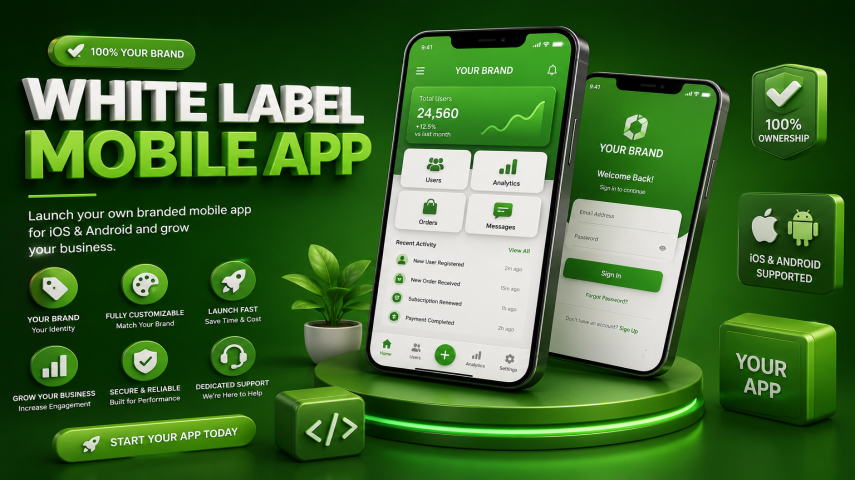
Custom Mobile Software vs White Label Mobile Apps
White label software is based on an existing product that can be branded and configured for different businesses.
It can be a useful option when speed and standard functionality are priorities.
Custom development provides greater freedom to create unique functionality.
White label may be suitable for:
- Faster launches
- Standard business models
- Limited customization
- Lower initial development requirements
Custom development may be suitable for:
- Unique business ideas
- Specialized workflows
- Complex integrations
- Unique user experiences
- Long-term product development
The decision should be based on the requirements rather than simply choosing the more expensive option.
Mistakes to Avoid When Building Custom Mobile Software
Building Too Many Features
A huge feature list can make development slower and more expensive.
Start with the essentials.
Skipping User Research
Without understanding users, businesses can build features customers don’t actually need.
Choosing Technology Too Early
The business requirements should come before technology selection.
Ignoring Backend Architecture
A mobile interface is only one part of a larger software system.
Forgetting Maintenance
Plan for updates and improvements after launch.
Choosing Developers Only by Price
A low initial quote can become expensive if the project requires extensive redevelopment.
How to Prepare Before Contacting a Development Company
You don’t need a complete technical specification before speaking with developers.
However, having the following information can make the conversation easier:
Business objective
What should the application accomplish?
Target users
Who will use the software?
Core features
What functionality is essential?
Platforms
Do you need iOS, Android, or both?
Integrations
What existing software should connect to the application?
Budget
What level of investment are you prepared to make?
Timeline
When would you like to launch?
The development team can help turn these requirements into a more detailed technical plan.
Questions to Ask a Mobile Development Company
Before hiring a development team, consider asking:
- Have you built similar applications?
- What development approach do you recommend?
- Which platforms will you support?
- Who owns the source code?
- What is included in the project price?
- How are additional features handled?
- What testing is included?
- How is the application secured?
- Do you provide post-launch support?
- What happens if requirements change?
Clear answers can help you choose a development partner with realistic expectations.
The Future of Custom Mobile Software
Mobile applications are becoming increasingly connected to other technologies.
Businesses are exploring:
- Artificial intelligence
- Automation
- Cloud computing
- Digital payments
- Real-time communication
- Data analytics
- Personalized experiences
- Connected devices
This means custom mobile software can become more than an application.
It can become part of a complete digital ecosystem.
Final Conclusion
Custom mobile software development provides businesses with an opportunity to build mobile technology around their exact requirements.
Whether the goal is to create an e-commerce platform, booking application, customer portal, employee tool, logistics system, marketplace, or specialized digital product, custom development provides the flexibility to create functionality that standard software may not offer.
The strongest projects begin with a clear business problem.
From there, businesses can define their users, prioritize features, design the experience, select the right technology, develop the application, test it thoroughly, launch it, and continue improving it over time.
Custom mobile software isn’t simply about having a mobile application with a company logo.
It is about creating a digital tool that makes a business more accessible, efficient, connected, and capable of delivering its services through mobile technology.
When existing software cannot meet your requirements, a custom solution can provide the flexibility to build something specifically designed for your business today while leaving room for tomorrow’s growth.