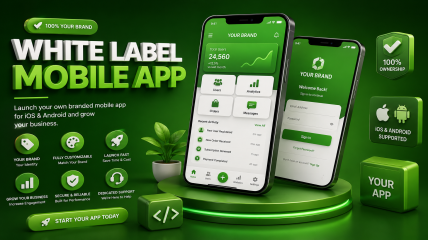
White Label Mobile App Development in 2026: How Businesses and Agencies Can Launch Branded Apps Faster
White Label Mobile App Development in 2026: How Businesses and Agencies Can Launch Branded Apps Faster
The demand for mobile applications continues to evolve in 2026.
Businesses no longer want mobile apps simply because having an app sounds modern. They want applications that help them sell products, communicate with customers, automate processes, collect data, increase loyalty and create new revenue streams.
At the same time, many companies do not want to spend months building an application completely from scratch.
This is where white label mobile app development comes in.
A white label mobile app allows a business to start with an existing technology foundation and customize it for its own brand, customers and business model.
For digital agencies, the opportunity can be even bigger. Instead of hiring a large development team, an agency can work with a white-label development partner and offer mobile applications to its clients under its own brand.
With AI, cross-platform development and app-building technology changing the development process in 2026, white-label mobile apps are becoming an increasingly interesting option for businesses looking for speed and flexibility. (Foresight Mobile)
What Is a White Label Mobile App?
A white label mobile app is an application based on an existing technology platform that can be customized and branded for another company.
Instead of creating the entire application from zero, the business uses an existing foundation.
The application may be customized with:
- Company name
- Logo
- Colours
- App icon
- Images
- Content
- Products
- Services
- Customer information
- Payment systems
- Notifications
- Business-specific features
The finished product can then be presented as the company’s own branded mobile application.
The exact level of customization depends on the provider.
Some white-label platforms offer simple branding changes, while more advanced white-label development services can provide extensive customization, integrations and custom functionality.
Why White Label Mobile Apps Are Trending in 2026
The biggest change in mobile development is that businesses increasingly expect technology to be delivered quickly.
A company may have an idea for an app today and want to test it in the market within weeks or months rather than waiting for a long development cycle.
Several trends are contributing to the growing interest in white-label mobile applications.
1. Artificial Intelligence
AI is becoming part of both the development process and the applications themselves.
Modern apps can use AI for:
- Customer support
- Personal recommendations
- Search
- Content generation
- Voice assistants
- Automation
- Data analysis
- Personalization
AI is also changing how developers build applications, making certain development tasks faster. (Foresight Mobile)
2. Cross-Platform Development
Businesses increasingly want applications that work across both iPhone and Android without maintaining completely separate development projects.
Cross-platform technologies such as Flutter and React Native have become important options for this type of development. Industry coverage in 2026 describes cross-platform development as a mainstream approach for many business applications. (DesignRush)
3. Faster Product Launches
Businesses want to test ideas quickly.
A white-label foundation can reduce the amount of repetitive development work required before an application reaches the testing stage.
4. Agencies Want New Revenue Streams
Marketing, SEO, branding and web agencies are increasingly interested in adding mobile app development to their service offerings.
White-label development allows an agency to sell the service without necessarily building a large internal mobile development department.
White Label Mobile App vs Building From Scratch
The biggest difference is where the development starts.
Traditional Custom Development
The process may involve:
Idea → Research → UX design → Architecture → Development → Backend → Testing → Deployment → Maintenance
Every major component may need to be designed and developed.
White Label Development
The process may look more like:
Existing platform → Branding → Configuration → Customization → Testing → Deployment
This does not mean every white-label app is simple.
Complex applications can still require custom programming, backend development and integrations.
However, the reusable foundation can reduce repetitive work.
The Biggest Advantage: Speed
For many businesses, time is more valuable than technology alone.
Suppose a company wants to launch a customer loyalty application.
A completely custom project might require extensive planning and development.
A suitable white-label platform could already contain:
- User accounts
- Loyalty points
- Notifications
- Customer profiles
- Admin management
- Basic analytics
The business may therefore spend more time configuring and customizing the product rather than creating every feature from the ground up.
This can help businesses reach the market faster.
White Label Apps for Digital Agencies
One of the strongest opportunities is the agency white-label model.
Imagine a digital marketing agency that already has 50 business clients.
Those clients may need:
- Websites
- SEO
- Advertising
- Branding
- Social media
- Mobile applications
The agency could add mobile app development to its service portfolio.
Instead of hiring several full-time developers immediately, it could partner with a white-label development company.
The workflow could look like:
Agency → White-label development partner → Client application
The agency remains responsible for the client relationship while the development partner handles agreed technical work.
This model is specifically attracting attention in 2026 because agencies can expand their service offering without necessarily building every technical capability internally. (Synthisia)
How the White Label App Reseller Model Works
The reseller model can be particularly interesting for entrepreneurs.
For example:
Step 1: Find a White Label Platform
Choose a platform that allows commercial rebranding and resale.
Step 2: Create Your Brand
Build your own business identity around the service.
Step 3: Create Packages
You might offer:
- Basic app package
- Professional app package
- Premium app package
- Custom enterprise package
Step 4: Find Clients
Potential customers can include:
- Restaurants
- Gyms
- Salons
- Retailers
- Coaches
- Schools
- Local businesses
- E-commerce companies
- Service businesses
Step 5: Customize the Application
Apply the client’s branding, content and required features.
Step 6: Launch
Publish or deploy the application according to the selected delivery model.
Step 7: Provide Ongoing Services
You can potentially generate recurring revenue through:
- Maintenance
- Hosting
- Updates
- Support
- Analytics
- Marketing
- App management
This turns a one-time development project into a longer-term business relationship.
Can White Label Apps Be Profitable?
They can be, but profitability depends heavily on the business model.
The important calculation is not simply:
Client price − development cost = profit
You also need to consider:
- Support
- Hosting
- Software licences
- Developer fees
- App-store costs
- Customer acquisition
- Maintenance
- Refunds
- Project management
- Updates
- Technical support
Agencies using white-label development can potentially improve margins by standardizing their delivery process and selling additional services around the application. Current agency-focused discussions emphasize recurring support, standardized delivery and maintaining the client relationship as important parts of the model. (Synthisia)
AI-Powered White Label Mobile Apps
AI may become one of the biggest differentiators between basic and advanced white-label applications.
A traditional white-label app might provide:
- Login
- Payments
- Notifications
- Profiles
- Content
An AI-enhanced application could add:
AI Customer Support
Users can ask questions and receive automated assistance.
AI Recommendations
The app can recommend products, services or content based on user activity.
AI Search
Users can search using natural language rather than exact keywords.
AI Content
Businesses can potentially generate or personalize content.
AI Automation
Routine business processes can be automated.
AI Voice
Voice-based interfaces can allow users to interact with applications without typing.
The key is not to add AI simply because it is fashionable.
The feature should solve a genuine business problem.
White Label Mobile Apps and Progressive Web Apps
Not every business needs a traditional App Store or Google Play application.
A Progressive Web App (PWA) can provide an app-like mobile experience through the web.
This creates another option for white-label businesses.
A PWA can potentially provide:
- Mobile-friendly design
- Home-screen installation
- Fast updates
- One codebase
- Lower maintenance requirements
- No traditional app-store publishing requirement
The important distinction is that a PWA is not the same product as a native mobile application.
If a business specifically needs an App Store listing or deep access to device capabilities, native or cross-platform development may be more appropriate.
Current 2026 discussions around white-label products increasingly distinguish between native apps, wrapped web applications and PWAs rather than treating all three as identical. (Dev Shop Vault)
What Features Should a Modern White Label App Have?
When choosing a platform, look beyond branding.
A modern solution may need:
User Management
Customers should be able to register, log in and manage their accounts.
Push Notifications
Businesses can communicate directly with users.
Payments
Depending on the business, payment functionality can support purchases, bookings and subscriptions.
Analytics
Analytics can help businesses understand how customers use the application.
Admin Dashboard
Businesses need an easy way to manage content and users.
API Integration
APIs allow the app to communicate with other business systems.
Cloud Infrastructure
The backend should be capable of supporting growth.
Security
Applications can contain sensitive customer and business information, making security a critical consideration.
Scalability
The platform should be capable of supporting more users as the business grows.
How to Choose a White Label Mobile App Provider
Do not choose a provider solely because it has the lowest price.
Ask these questions first.
Does the provider allow commercial resale?
Some platforms allow you to create an app for your own company but do not permit unrestricted resale.
Who owns the source code?
This is particularly important for agencies and businesses that want long-term independence.
Who owns the app-store accounts?
Determine whether the application will be published under:
- Your account
- Your client’s account
- The provider’s account
Can you export your data?
Ask what happens if you decide to leave the platform.
Can you change the backend?
Some platforms provide little control over the underlying infrastructure.
How much customization is available?
Ask for specific examples rather than accepting vague promises such as “fully customizable.”
What happens after launch?
Understand the provider’s:
- Support policy
- Maintenance policy
- Update process
- Security policy
- Pricing model
Common White Label Mobile App Mistakes
Mistake 1: Choosing Based Only on Price
The cheapest provider may not be the cheapest solution over several years.
Always consider the total cost.
Mistake 2: Ignoring Ownership
Make sure you understand who owns the code, data, accounts and intellectual property.
Mistake 3: Overloading the First Version
Do not attempt to add 100 features immediately.
Start with the features that solve the core problem.
Mistake 4: Ignoring User Experience
A branded application can still fail if it is difficult to use.
Good UX matters just as much as the technology.
Mistake 5: Forgetting Marketing
Building the app is only the beginning.
You still need customers to download and use it.
White Label Mobile App SEO Strategy
If your goal is to market white-label mobile apps online, do not rely on one keyword.
Build a content cluster around the main topic.
Your main pillar page can target:
White Label Mobile App
Supporting articles can target:
- White Label Mobile App Development
- White Label App Builder
- White Label App Development for Agencies
- White Label Mobile App Pricing
- White Label App Reseller
- Best White Label App Builder
- White Label App vs Custom App
- How to Start a White Label App Business
- AI White Label Mobile Apps
- White Label Apps for Small Businesses
- White Label Apps for Agencies
- How to Launch a Branded Mobile App
- White Label iOS and Android Apps
- White Label SaaS Mobile App
Each supporting article should link back to the main pillar page.
This creates a stronger topical structure than publishing unrelated blog posts.
How to Build a White Label Mobile App Business
If you want to turn white-label apps into a business, start with a specific niche.
Instead of advertising:
“We build mobile apps for everyone.”
you could target:
“Branded mobile apps for restaurants.”
Or:
“White label mobile apps for gyms.”
Or:
“Mobile apps for local service businesses.”
A focused niche can make your marketing message much clearer.
You can then create:
- A website
- A service page
- Pricing packages
- Demonstration apps
- Case studies
- Industry-specific landing pages
- Educational blog content
- A sales process
- Client onboarding
- Ongoing support packages
What Will White Label Mobile Apps Look Like in the Future?
The next generation of white-label applications is likely to be much more than a logo placed on an existing template.
The strongest platforms will increasingly combine:
Branding + AI + Automation + Analytics + Payments + Personalization + Cross-platform technology
Businesses will expect applications to be:
- Faster
- Smarter
- Easier to update
- More personalized
- More secure
- More integrated
AI and cross-platform development are among the major technology themes shaping mobile development in 2026. (Foresight Mobile)
Final Verdict
A white label mobile app can be an effective solution for businesses that want a branded mobile presence without taking on the full complexity of building an application from zero.
For agencies, the opportunity can be even greater.
A reliable white-label development partner can allow an agency to expand beyond traditional marketing services and offer mobile applications while maintaining the client relationship.
However, success depends on choosing the right platform and understanding the commercial agreement.
Before starting, investigate:
- Pricing
- Customization
- Source-code ownership
- Data ownership
- App-store publishing
- Scalability
- Security
- AI capabilities
- Integrations
- Support
- Maintenance
- Exit options
The goal should not simply be to launch an app.
The goal should be to build a mobile product that customers actually want to use and a business model that can continue generating value after launch.
In 2026, white-label mobile app development is moving beyond simple rebranding. The opportunity is increasingly about combining reusable technology with strong branding, AI, automation and specialized business solutions.
For the right business, that can make the difference between spending months building technology and getting a useful mobile product into customers’ hands much sooner.
Frequently Asked Questions
What is a white label mobile app?
It is an existing or reusable mobile application solution that can be customized and branded for another business.
Can I sell white label apps to other businesses?
Yes, if the provider’s licensing agreement permits resale or white-label commercial use.
Can a white label app have my company’s logo?
Yes. Branding is one of the primary purposes of white-label technology.
Can white label apps use AI?
Yes, depending on the platform and available integrations. AI chat, recommendations, automation and personalization are possible examples.
Can white label apps work on iOS and Android?
Many solutions can support both platforms, particularly when cross-platform development is used.
Is a white label app cheaper than custom development?
It can be, particularly when the application can use existing functionality rather than requiring everything to be developed from scratch. However, pricing varies significantly by provider and project complexity.
Can an agency make money selling white label apps?
Yes. Agencies can package mobile development with design, marketing, maintenance, support and other services. The actual margin depends on acquisition costs, provider fees, pricing and ongoing support requirements.
Is a white label mobile app good for a startup?
It can be especially useful for startups that want to validate a business idea quickly before investing heavily in a completely custom technology platform.